
The Rails Economy: Markets, Memes, and Why Control Now Pays Better Than Profit
Local & Community
Advisory & Growth
Super & Retirement
Property & Investing
Cost of Living
Opinion
Preface
This isn’t a manifesto, and it’s not investment advice. It’s my working notes from the last five years — an accountant’s attempt to join the dots between central banks, platforms, private funds, and the strange incentives now steering prices. I’m writing it because the story most of us were taught about capitalism (make something useful, sell it at a profit, get rewarded) explains less each year. Control explains more.
You’ll see pieces you recognise: the COVID money flood, zero‑commission trading, the GameStop short squeeze, private equity roll‑ups, and the quiet conversion of one‑off purchases into subscriptions. I’ll also spell out what this means for Australians: our dependence on the U.S. dollar, how global rails map onto local realities, and simple steps to make households and small firms a bit less fragile.
When the Plumbing Stopped Matching the Story (2020)
In early 2020 I started paying closer attention to the plumbing — the boring bits under the economy. Demand froze, borders closed, and markets lurched. Then came the policy firehose: near‑zero interest rates, bond‑buying programs, and fiscal support to households and firms. In Australia and the U.S., cash landed in bank accounts while asset prices raced ahead of incomes. Within months, equity indices were printing new highs while real activity was still limping.
As a numbers person, that divergence was hard to ignore. Profits didn’t seem to be driving valuations. Dominance did. The businesses that recovered fastest were the ones sitting between buyers and sellers — the marketplaces, cloud providers, app stores, ad networks, and logistics rails. If you owned the gate, you did fine. If you made the product and paid the toll, you were a price‑taker.
The takeaway I couldn’t unsee: we still call it capitalism, but the compounding now accrues to control more than to production.
From Profit to Power: How the Rails Business Works
The modern playbook looks like this:
Subsidise: Price under cost to grow users and starve rivals. Losses are a feature, not a bug.
Lock in: Build switching costs — convenience, contracts, formats, and habit loops.
Monetise the gate: Once usage concentrates, raise take‑rates, add fees, sell priority and data.
Financialise the flow: Package the cashflows, add debt, harvest fees through structures.
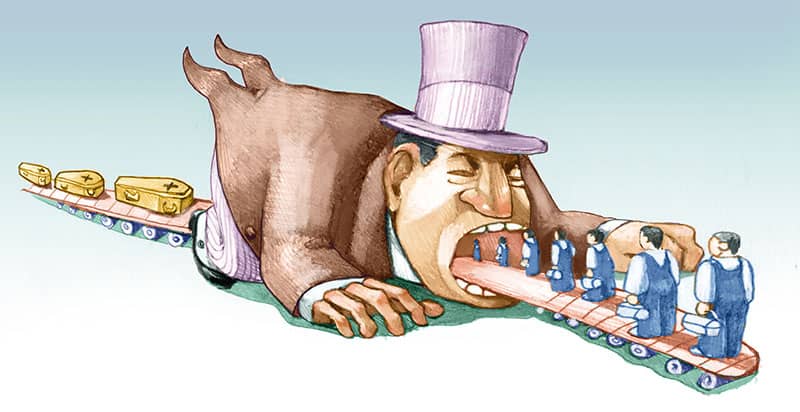
That’s why so many category leaders ran years of red ink and still attracted capital. They weren’t building products; they were laying rails. Once they owned the chokepoints, profit could be summoned later with a few percentage points of fee or a price‑rise disguised as a bundle.
This logic escaped the tech sector long ago. It’s in healthcare, retail, freight, food delivery, software, payments, even pet vets and physio chains. The middle layer (intermediaries) captures more of the value than the maker or the buyer.
The new wrinkle is that the rails are now embedding intelligence. AI models and recommenders are becoming rails themselves — intermediating not just transactions but decisions. Whoever owns the interface between humans and choices gets to tax intent. That’s the next rent frontier.
Private Markets, Public Consequences
In the 1990s, a small slice of the economy sat in private equity portfolios. Today it’s a large slice. The method is straightforward: buy, lever up, streamline, raise fees, sell. It’s tidy on a spreadsheet, but the incentives are short‑term. Holding periods have lengthened because exits are harder, but the centre of gravity remains off‑exchange and out of public view. For most savers, that means less direct access to productive assets and more layers of fees between your superannuation and real activity.
At the same time, public markets have fewer listings but higher concentration. Index investors — perfectly sensible on average — end up owning more of a shrinking cohort of rail‑keepers. The system works until flows reverse, or until a chokepoint fails.
Private control with public risk — that’s the quiet trade of the last decade.
The Meme That Broke Market Structure (GameStop 2021)
We can’t talk about post‑2020 markets without the GameStop saga. Not because of the dollar amounts, but because it revealed the wiring.
The setup: years of ultra‑low rates and QE pushed investors into risk. Zero‑commission trading arrived. Lockdowns left people at home with time, stimulus cash, and new mobile broker apps. Meanwhile, professional funds had crowded into short positions against struggling “old world” companies. In GameStop’s case, short interest exceeded the available float — an extreme that left those funds exposed if the price ever moved up fast.
What happened: a retail swarm spotted the setup and bought shares and call options, forcing market makers to hedge by buying stock, which pushed prices higher, which forced shorts to buy back shares, which pushed prices higher again — a classic short squeeze amplified by options hedging (gamma dynamics). Prices detached from fundamentals because the game wasn’t about value; it was about balance‑sheet survival for the shorts and reflexive flows from hedging.
What we learned:
Market plumbing (clearing, collateral, and risk haircuts) can force trading platforms to limit buys during stress. When one popular broker restricted purchases, it wasn’t a conspiracy in the cartoon sense; it was collateral math under stress. That doesn’t make the outcome fair — only explainable.
The “little guy vs big guy” narrative was incomplete. Some large institutions rode the squeeze profitably. Rail‑owners win both ways: on the way up (volume, spreads) and on the way down (the same).
Social coordination can move prices for a while, but plumbing wins in the end. When collateral calls rise, the music stops fast.
GameStop wasn’t just drama; it was a stress test. It showed how much price now depends on flow mechanics and policy settings, not just discounted cashflows. It also showed how quickly behavioural coordination collides with structural rails owned by someone else.
Managed Funds, Moral Hazard, and the COVID Accelerant
The same period highlighted something older: moral hazard. In 2008, system‑critical balance sheets were rescued while households absorbed the pain. In 2020, relief was broader — households received cash — but the fastest recovery was still in asset prices, not wages. Buying corporate bonds and mortgage paper pushed yields down and valuations up. Capital flowed to those best positioned to capture rather than create value.
Retail participation surged for understandable reasons: spare time, cash supplements, boredom, and the easy dopamine loops of mobile trading. Some flows found genuine long‑term investments. A lot chased stories and volatility. On the institutional side, many funds happily shorted names with weak narratives. A few rode those shorts too far and were rescued by partner capital. Meanwhile, government and central‑bank support stabilised credit segments where institutions lived. The tail again wagged the dog.
I don’t blame individuals for buying stocks with their COVID cash — in a near‑zero yield world, it made emotional sense. But it fused politics and markets tighter. A future drawdown won’t just hit balance sheets; it’ll hit trust.
Digital Sharecropping: Who Actually Creates the Value?
The platform economy runs on content, labour, and data. Most of that is supplied by us — often free, sometimes for micropennies, rarely on durable terms. If you write, design, drive, deliver, stream, or sell on someone else’s rails, you’re a tenant. You might do very well, but the landlord sets the rules, rent, and visibility.
AI slots into this neatly. Assistants and recommenders are being spliced into every workflow. It’s not just about helping you type faster; it’s about inserting a broker at the moment of decision — search, compare, buy — so someone else can take a cut and capture your behavioural exhaust. Once the assistant is your default, the rail owns your intent.
Control is moving from distribution to cognition.
The Price/Value Divorce
Warren Buffett’s line — “price is what you pay, value is what you get” — survives because it’s simple. Over the last 25 years we’ve complicated it with leverage, derivatives, buybacks, passive flows, and platforms that tax the top of the funnel. None of these are evil. Together they can detach prices from productive value for long stretches. Cheap money stretches the rubber band further.
That’s why a meme stock can rocket while a profitable manufacturer flatlines. It’s why an unprofitable rail‑keeper can be worth more than a dividend‑payer with factories. Price responds first to flows and rails. Value shows up later — or not.
So What Actually Ends This? (And What “Ending” Means)
People keep asking when this ends. My view: systems like this don’t end so much as recode. A clean reset would require either a credit accident large enough to force deleveraging across rails, or a policy regime that decisively re‑prices risk and labour for a long time. More likely is another wobble, another patch, and an even higher reliance on the same intermediaries. The rails don’t shrink; they just get new safety rules.
If you’re waiting for a cinematic “end,” you’ll miss the grind: higher fees for access, more subscriptions, more private control of public chokepoints, and more politics living inside plumbing — clearing, collateral, standards, app rules, ad auctions. Not apocalyptic — just tighter.
Australia: Downstream from the Dollar
Here’s the local reality:
We import the cost of money. The RBA sets our cash rate, but global credit conditions are set by the U.S. Federal Reserve and the U.S. dollar. Our banks fund offshore; our corporates issue in USD; our big super funds benchmark against U.S. assets.
Our asset prices are dollar‑sensitive. Commodities are priced in USD. When the greenback surges, the AUD weakens. That’s handy for miners, awkward for importers, and inflationary for households.
Our rails are American. The ad markets that feed local media, the app stores on our phones, the cloud platforms hosting our data, the social feeds that steer attention — nearly all are U.S.‑controlled networks with U.S. incentives. Policy levers exist, but they’re slow.
Our households are levered to property. That’s not moral judgment; it’s structure. Cheap global money and tight land supply pushed values up. When global rates jump, the pass‑through is brutal because we actually roll our mortgages. Households become shock absorbers.
None of this is despair. It just means we are a price‑taker on the cost of money and the rules of many rails. We can still choose how much dependency we accept.
What Australians Can Do (Households and Small Firms)
A few practical moves that don’t require a revolution:
Households
Reduce platform dependency: Prefer direct relationships — direct banking, direct insurance, direct energy plans, direct merchant purchases when price is comparable.
Tidy the subscription creep: Once a quarter, list every recurring debit. Kill two. Cap the total at a number that lets you still save.
Hold buffers: In a floating‑rate country, rate shocks hit fast. Aim for a cash buffer that covers your mortgage and essentials for a few months.
Own the things you use daily: Ownership is an inflation hedge when the service layer keeps repricing.
Small businesses
Multi‑home your channels: Don’t bet the farm on a single ad platform, marketplace, or feed. Build one owned channel (email, SEO, partnerships) every quarter.
Make the toller replaceable: Use payment gateways, shipping tools, and SaaS where you can export your data and swap providers without rewrites.
De‑risk your revenue: Mix retainers with projects. Prefer contracts that auto‑renew but you can cancel. If you must accept platform work, use it to build off‑platform clients.
Document and standardise: The easier it is to switch vendors or tools, the more bargaining power you have when prices rise.
Investors (general)
Know what you actually own: Broad indices make sense, but they’re concentrated in a few rails heavy on U.S. policy.
Respect liquidity: Things that trade like water on the way up can trade like sand on the way down. If you don’t understand the gatekeepers, size it small.
Tying It Together: GameStop, Bailouts, and the Rails Lesson
GameStop made headlines because it felt like justice. A crowd spotted over‑extended shorts, pushed back, and for a moment the scoreboard flipped. But look at the wiring underneath:
Why were shorts so crowded? Because cheap money and narrative momentum made it painless to lean on weak incumbents.
Why did retail flows surge right then? Because stimulus, zero‑commission apps, and boredom made the perfect accelerant.
Why did platforms restrict buys? Because clearinghouses and collateral rules tightened the rails when coordination mattered most.
Who won regardless? The intermediaries. Volume is revenue. Spreads are revenue. Payment for order flow is revenue. Data exhaust is revenue. Rail‑owners win both ways unless the rails themselves break.
And when balance sheets at the top wobble, help arrives fastest at the top. Not always from government cheques — often from partner capital, central‑bank facilities, or rulebooks designed to protect pipes first and users second. That’s not a conspiracy; it’s how systems preserve themselves.
The lesson isn’t “don’t fight City Hall.” It’s “own more of your own rails.” The closer you are to a chokepoint you control — your customer list, supply relationships, processes, your local network — the less any single platform can reroute your life overnight.
The USD Question
Will the U.S. dollar lose dominance? Not quickly. There’s no clean substitute: the euro is a patchwork; the yuan isn’t convertible; commodity‑linked options are too narrow; crypto is volatile and policy‑sensitive. For Australia, that means:
We price exports in USD and import a lot of tradables. A strong USD weakens the AUD, raising local prices.
Our super funds and banks sit on USD exposures. Hedging helps but isn’t free or perfect.
Policy independence is narrower than slogans suggest. If the Fed tightens, we feel it. If the Fed rescues something, our asset prices breathe relief too.
Preparation doesn’t mean paranoia. It means designing lives and businesses that can function across a range of dollar outcomes: strong, weak, sideways, noisy.
A Short Glossary
Short selling: Borrow a share, sell it, hope to buy it back cheaper later. If the price rises, losses grow.
Short squeeze: When shorts must buy back shares as prices rise, which pushes prices up further.
Clearinghouse: The plumbing between trades ensuring settlement. Under stress, it demands more collateral.
Payment for order flow (PFOF): Brokers sell your trade flow to market‑makers who earn the spread. You get zero commission; they get data and pennies‑per‑trade at scale.
QE (quantitative easing): Central banks buy bonds with new reserves to push down yields and support credit.
Intermediary/rail: A platform that sits between buyer and seller and takes a fee for access.
Where I Land
Capitalism isn’t dead. It’s been rerouted. Profit still matters, but control has the steeper compounding curve. The more of your life you route through someone else’s rails, the more you pay rent — in money, data, and optionality. The more of your own rails you build and maintain, the calmer the shocks feel.
For Australians, this is doubly true. We ride a dollar we don’t issue on rails we don’t own. That’s fine — until it isn’t. Our edge will be small, resilient systems: local suppliers, direct customer relationships, sane balance sheets, and boring profits that don’t depend on one algorithm’s mood.
I’m not forecasting doomsday. I’m forecasting friction. Fees creep. Subscriptions multiply. Policy toggles show up where you thought there was “just an app.” None of this stops you building a good life or a solid business. It just changes which levers matter.
Own what you can. Rent what you must. Keep switching cheap. And whenever you can, step off someone else’s conveyor belt long enough to remember what you were trying to build in the first place.
— Aidan Walmsley, 2025